The Ultimate Hitchhiker's Guide to Verification

Dumping ground of useful links/articles/tips/tricks on System Verilog/VMM/OVM as and when I stumble upon them and some of my views on it :)

Showing posts with label Written by Subash. Show all posts

Writing SystemVerilog assertion for checking "setup/hold time violation" type of conditions

Recently, I gave couple of internal lectures on basic and advanced features of SystemVerilog assertion at the organization that I am working at. After that, quite a few colleague of mine have started asking questions on SVA. Amongst all, the most interesting assertion question is how to write assertion for checking "setup/hold time violation" type of scenarion. To understand these scenario, let's start with a very common example, which can be extended for many similar case.

Problem statement:
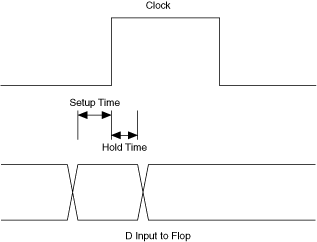
Write assertion for checking that the signal "data" is stable for tSetup time before positive edge of clock, and should be stable for tHold time after positive edge of clock. Here tSetup/tHold will be of static delay like 1ns, 30ps or so on. There are no extra inherent assumptions added with it (like clock period, its relationship with tSetup/tHold, or how fast the signal data can toggle.
This is a standard problem, with not so easy solution of writing assertion for it

In Verilog there is a way of checking it, which unfortunately is not an assertion, and hence can't be used with formal tools like Jasper. (via http://www.edaboard.co.uk/requesting-help-on-writing-sv-assertions-t442372.htmlhttp://www.edaboard.co.uk/requesting-help-on-writing-sv-assertions-t442372.html)

module timing_checks (input clk, en); 
  specify 
    specparam clk_high_time = 5; 
    specparam clk_low_time = 5; 
    $setup(en, negedge clk, clk_high_time * 4 / 5); 
    $hold(negedge clk, en, clk_low_time * 4 / 5); 
  endspecify 
endmodule 

Now let's proceed with assumption that we want to write an assertion for checking the same, we are not very much happy with $setup/$hold of Verilog. Here is the solution

module timing_checks_in_sv (input clk, data, ...); 
  ...
  event ev_data_delayed_toggled;
  
  always @(data)
  begin
    fork
    begin
      # tSetup;
      -> ev_data_delayed_toggled;
    end
    join_none
  end

  property setup_hold_time_checker;
    time curr_time;
    @(posedge clk) (1, curr_time = $time) |->
    @(ev_data_delayed_toggled) (($time - curr_time) > (tSetup + tHold));
  endproperty : setup_hold_time_checker

  ASSERT_SETUP_HOLD: assert property setup_hold_time_checker;
endmodule 

In the always block, we are triggering an event called ev_data_delayed_toggled, after tSetup time every time data toggles. Now the "setup/hold time" problem statement can be written as after posedge of clock, ev_data_delayed_toggled shouldn't get triggered within tSetup+tHold time. Now the problem statement has come to a form SVA timing check, which is specified in via the property.

There are many such not so intuitive, interesting use-case scenarios for SVA. Interested readers can have a look at the below link for some more interesting scenarios.

Advanced SystemVerilog Process Control – Beyond fork-join_X


Abstract— All the Hardware Verification Languages (HVL) have an inherent requirement to have process control capabilities like creation, control and destruction of process. Although Verilog language has incorporated such capabilities like named blocks and fork-join statements, but SystemVerilog has further extended these properties of verilog with introduction of fork-join_X, disable fork and fine grain process control. ―Fine grain process control is the least understood and least used capability amongst all the SystemVerilog process control capabilities. The main reason behind the same is due to the fact that SV LRM[1] has very brief and concise description (about two pages) of fine grain process control. This paper aims in de-mystifying the above constructs and shows the use of fine grain process control for much more flexible processes creation, their control as well as destruction capabilities. It discusses how per-instance-based process control and decoupling of ―how and when can be done using SV fine grain process control

Index Terms—Fine grain process control, Inbuilt process class of SystemVerilog, Per-instance based process control, Decoupling of how and when of processes.

I. INTRODUCTION
Process control capabilities like creation, control and destruction of processes are inherent requirements of any Hardware Verification Language. Verilog has named block, fork-join construct for controlling process creation, control and destruction. Below example will show some of the capabilities of verilog process control.

always @(posedge req) begin 
  fork 
  begin : Label1 
    wait(a); 
    disable Label2; 
  end 
  begin : Label2 
    wait(b); 
  end 
  join 
end
In the above mentioned code snippet, we are creating two threads named “Label1” and “Label2” at every posedge of req. In the thread “Label1”, as soon as signal “a” becomes HIGH, it kills the thread “Label2”.

But, there are few limitations in Verilog’s process creation, control as well as destruction. The main limitation of verilog’s fork-join statement is that there is very less flexibility in terms of when it should get out of fork loop. In addition, disabling of named block is not a good way of killing a process.

SystemVerilog solved the 1st limitation of verilog’s process control capabilities by adding new constructs like join_any, join_none, disable fork and wait fork. These constructs are widely used for controlling process creation/control/destruction.

However these constructs have further few limitations for finer control of process. Using the above constructs, we cannot suspend/resume/kill only a specific single process. SystemVerilog has a feature called “Fine grain process control” using which we can have much finer control on creation/control/destruction of process.

II. FINE GRAIN PROCESS CONTROL
Fine grain process control is meant for having finer control on processes compared to the control one can get using fork/join_x constructs. This is done using SystemVerilog’s inbuilt class called ’process’. Let’s look at the various feature of the above class and how to use them for finer control of processes.

A. Handle Creation and status check
To control any process/thread, we need to get the handle of the above thread using calling “process::self()” method of process class. Below code snippet will show how to do the same.

task abc(…); 
  process P; 
  process::state Pstate; 
  … 
  fork 
  begin 
    P = process::self(); 
    … 
    Pstate = P.status(); 
  end 
  join_none 
endtask : abc

A process can be created for each always, initial block, and begin…end statement inside fork…join_X and dynamic processes. In addition, we can check the status of any process by calling status() method. A process can be in either of these 5 states (FINISHED, RUNNING, WAITING, SUSPENDED, KIL). “process::state” is a enumerated value and its content can be displayed using .name() method.

B. Process Suspension, Resumption, Await and Kill
Any process can be suspended or resumed by calling suspend() and resume() task of process class. Similarly, the process can be terminated by calling kill() method. The await() method blocks till the process is terminated. SystemVerilog code snippet given in section “USE-CASE: FINER CONTROL OF PROCESS”.

There can be few race conditions when a process is waiting for some event/variable change and we suspend the process. The question is on what condition the process shall resume its execution. These are simple rules to know when the process shall get unblocked from the waiting event[2]
  1. If the process is waiting for a delay like (#100 or #20ns) while going to suspend state, it will not count the time spent while in suspend state as the delay.
  2. If the process is waiting for an event (@(SV_event)) while going for suspend state, and the event has occurred when the process is at suspend state, then the process will be unblocked, and will start executing from the next while after resuming.
  3. If the process is waiting for variable change (@(SV_variable) or wait(SV_variable)) : Check for change of the variable is not performed when the process is suspended and hence any variable change happened during the time when the process is in suspended state shall not unblock the process if it is waiting for variable change and is put to suspend state
 
 III. USE-CASE: PER-INSTANCE BASED FINER CONTROL OF PROCESSES.
Consider a scenario where we have created some N numbers of thread/process in one task. From another task, we want to suspend/resume/kill selected few tasks depending upon some other external conditions. Fine grain process control is extremely well suited for these kinds of tasks. Let see an example code snippet to understand how it can be done.

class fine_grain_process_ctrl_example;
 
  // Data members
  process p[20];        
  …

  task spawn_thread;
    for(int i=0; i<20; i++)
    begin
      fork
      begin
        p[i] = process::self();
        run_thread();
      end
      join_none
    end       
  endtask: spawn_thread
 
  task control_thread;
    …
    // condition met for suspending p[i]
    p[i].suspend();
    …
    // condition met for resuming p[j]
    p[j].resume();
    …
    // condition met for killing p[k]
    p[k].kill();
    …
    // Wait for completion of p[l]
    p[l].await();
  endtask: control_thread
endclass: fine_grain_process_ctrl_example

In the above code snippet, we have a class called fine_grain_process_ctrl, which has an array of process handles. In the task spawan_thread, where we are creating 20 parallel threads (by calling some external task run_thread()), we are also storing the handle of the process into the process array. Now in the task control_thread, we are controlling the suspension/resumption/termination of the above threads (which can be done in per-instance basis) depending upon some condition).

There is another advantage of the above way of doing the process control. Here effectively, we are de-coupling what to do in the thread, and how to handle thread. This decoupling is very useful for code-reuse. The details of the above aspect are described in more detail in next section.

IV. USE-CASE: DECOUPLING HOW AND WHEN


Consider a case where you have already written a transactor which sends packets according to your requirements. Now you need to change your code to make it work in the low-power-world where you need to stop sending packets whenever the system enters low-power state and resume sending packet once you are out of it. You have coded “HOW” to send your packet, and now you need to incorporate “WHEN” to send it, which itself can be far more complex that the simple “HOW”.

You can directly go and modify the transactor code to incorporate “WHEN” aspect of the packet transmission. There are quite a few reasons why you would rather not touch the code and do the same in another way.

Fine grain process control can be very nicely used in such scenario. You can have a handle of the process of sending packet. Now using this handle, we can stop/resume execution of the process (thereby stopping/resuming sending of packet) by calling suspend/resume method. We can have another piece of code where we can code the logic which will have the logic that shall control “WHEN” to send the packet.

REFERENCES
[1] "IEEE Standard For SystemVerilog - Unified Hardware Design, Specification and Verification Language," IEEE Computer Society, IEEE, New York, NY, IEEE Std 1800-2009
[2] Article on “Fine Grain Process Control” at Synopsys Solvenet
  1. https://solvnet.synopsys.com/retrieve/025656.html
  2. https://solvnet.synopsys.com/retrieve/025657.html
  3. https://solvnet.synopsys.com/retrieve/025658.html
What is Factory Pattern - v2.0

This post is a extended version of my original post on factory pattern which can be found at http://learn-systemverilog.blogspot.com/2009/08/what-is-factory-pattern.html

If you are working in System Verilog/VMM environment, it is high likely that you will be bombarded with word/expression from OOP world like "Factory Pattern", "Facade Pattern", "Observer Pattern" and so on. There is a finite possibility that you will seat down and start thinking what does those word mean and why they were used too frequently. Let me try to explain the idea/concept behind such word in the simplest way possible.

In SW engineering, a design pattern (or simply pattern) means a general repeatable solution to a commonly occurring problem. Most of these patterns have similarity to something or other in human society and hence they are known by that name.

Factory pattern as the name suggest, is aimed at solving the issue of creation of object. (Factory pattern is not the only pattern to deal with creation of objects, there are a bunch of more patterns for handling different kind of cases, and collectively they are known a creational patterns)

Let me give an example of case where we might need to use creational pattern and how to do so it in SV. Suppose you want to create a "Toy Factory" class which needs to create multiple types of toys (say toy aeroplane, toy tank, toy bus) depending upon the string input to it.

To create these different types of toys we need to have class defined for them. And there will be common method and data interface for these classes, hence it make sense to put all the common data member/task/functions in a class called toy class and then extend it.

class TOY;
    // Common data memeber
    string toy_name;

    // Common methods
    virtual function string get_type();
endclass : TOY

class TOY_Tank extends TOY;
    function new();
        this.toy_name = "Toy Tank";
    endfunction : new

    string function string get_type();
        return this.toy_name;
    endfunction : get_type
endclass : TOY_Tank

class TOY_Bus extends TOY;
    function new();
        this.toy_name = "Toy Bus";
    endfunction : new

    string function string get_type();
        return this.toy_name;
    endfunction : get_type
endclass : TOY_Bus

Now we are done with the bothering about the objects to be created. The next problem that we need to solve is to write the toy factory class itself. For simplicity, let's consider the case where we will want to pass 1 to get an instance of tank class and 2 for getting an instance of bus class from the factory. Now the factory class will look like this.
class TOY_factory;
    Toy my_toy

    // Common methods
    function toy get_toy(string str);
        if(str == "Toy Tank") this.my_toy = new TOY_Tank();
        if(str == "Toy Bus")  this.my_toy = new TOY_Bus();
        return this.my_toy;
    endfunction : get_toy
endclass : TOY_factory

Note that we are using virtual function for bringing polymorphism in action and save us from having an individual instance of the toy type in the factory class.

Reference


Note
Mike Mintz has added the following word of caution/note for this in the thread http://verificationguild.com/modules.php?name=Forums&file=viewtopic&t=3763

The above link is very good. I would just like to add a word of caution. The factory pattern should be rather rare in your architecture. While the choice of where to put the "new" for a class is very important, most of the time (for big components) the answer is in the testbench. That's where all the drivers,generators,monitors, etc should be built.

Also the factory pattern is usually implemented as a function, not a class. When it's a class, you can get sloppy with the necessary parameters and you code is harder to follow.

I understand pretty well the warping of these cautions caused by the three letter methodologies and their misguided quest for generic components, so your usage may have to follow their guidelines. Just remember that (1) in the real world factory patterns are rare, and (2) you do not always have to do it the way the methodology says.

    Some interesting ways to get a delayed version of signal in SV

    In TB world, sometime you will need a signal which is N clock delayed version of another signal. You can do it by using 9 intermediate variables, or use these.

    // I want 10 clock delayed version of signal abc
    always @(posedge clk) begin
        abc_10_clk_delayed_1 <= $past(abc, 10); // This works in vcs
        abc_10_clk_delayed_2 <= repeat(10) @(posedge clk) abc;
    end
    

    System Verilog `define macros : Why and how to use them (and where not to use!!!)

    I most confess, I have become a very big fan of SystemVerilog `define macro for the amount of effort I save because of using it. The big advantage of using this is that you can concisely describe your intention in a more readable (and less SystemVerilog syntax) using macro. Another advantage is you need to change only at one place if you find out that you need to change the expression you have used in 100 of places. The 3rd reason is that it is widely used in industry. Some example worth quoting are

    1. Using SystemVerilog Assertions for Functional Coverage
    2. Using SystemVerilog Assertions for Creating Property-Based Checkers
    3. SystemVerilog Assertions Design Tricks and SVA Bind Files
    4. VMM and especially VMM data macro
    Next question : Where shall I get the required info on how to use SystemVerilog `define macro
    Ans : Web (thanks to the all powerful demi-god of internet ... Google)
    1. http://www.google.co.in/#hl=en&safe=off&q=Systemverilog+Macro 
    2. System Verilog LRM 3.1a : Section : 25.2
    3. Sandeep Vaniya's Advanced Use of define macro in SystemVerilog (not so advanced actually !!!)
    From reading these it might be apparent that define macro can be used for adding a postfix to the variable, but not prefix. I was thinking the same after reading the description (they don't have a single example of adding prefix to the variable via `define. Confused ?? Let me explain by giving a concrete example

    // Example macro for a coverage class
    // Aim : want to get ABC_cp : coverpoint ABC {bins b = {1}; }
    // by calling `COV(ABC)
    `define COV(__name) __name``_cp : coverpoint __name {bins b = {1}; }
    
    // Next
    //     What to do if I want cp_ABC in place of ABC_cp as for the above example
    //     NOTE : I can't use cp_``__name as cp_ is not an input to the macro
    
    // Solution
    //     Use nested macros
    `define PREFIX(__prefix, __name) __prefix``__name
    `define COV2(__name) `PREFIX(cp_,__name) : coverpoint __name {bins b = {1}; }
    
    
    Nested macro is not a new thing in SV. They are being extensively used in VMM data macro class. But no example of nested macro and achieving of addition pre_fix to variable name in `define macro is bit puzzling to me. I tried the above in vcs and seems to work perfectly fine.

    Next, where not to use `define (SV other better alternatives to `define these cases)
    1. New Verilog-2001 Techniques for Creating Parameterized Models (or Down With `define and Death of a defparam!): Bit old but still usefull

    Answers to SystemVerilog Interview Questions - 8

    13. What is the difference between mailbox and queue?
    Ans:-
    Mailbox are FIFO queue, which allows only atomic operations. They can be bounded/unbounded. A bounded mailbox can suspend the thread (while writing if full, while reading if empty) via get/put task. Thats why mailbox is well suited for communication between threads.

    24. What is the use of $cast?
    Ans:-
    Typecasting in SV can be done either via static casting (', ', ') or dynamic casting via $cast task/function. $cast is very similar to dynamic_cast of C++. It checks whether the casting is possible or not in run-time and errors-out if casting is not possible.

    27. What is $unit?
    Ans:-
    Refer these 2 doc form more details

    1. http://www.systemverilog.org/pdf/SystemVerilog_Overall_31A.pdf 
    2. SV LRM 3.1a :: Section 18.3

    28 .What are bi-directional constraints?
    Ans:-
    Constraints by-default in SystemVerilog are bi-directional. That implies that the constraint solver doesn't follow the sequence in which the constraints are specified. All the variables are looked simultaneously. Even the procedural looking constrains like if ... else ... and -> constrains, both if and else part are tried to solve concurrently. For example (a==0) -> (b==1) shall be solved as all the possible solution of (!(a==0) || (b==1)).

    29. What is solve...before constraint ?
    Ans:-
    In the case where the user want to specify the order in which the constraints solver shall solve the constraints, the user can specify the order via solve before construct. i.e.

    ...
    constraint XYZ  {
        a inside {[0:100]|;
        b < 20;
        a + b > 30;
        solve a before b;
    }
    

    The solution of the constraint doesn't change with solve before construct. But the probability of choosing a particular solution change by it.

    40. What is circular dependency and how to avoid this problem ?
    Ans:-
    Over specifying the solving order might result in circular dependency, for which there is no solution, and the constraint solver might give error/warning or no constraining. Example

    ...
    int x, y, z;
    constraint XYZ  {
        solve x before y;
        solve y before z;
        solve z before x;
        ....
    }
    

    Answers to SystemVerilog Interview Questions - 7

    4. What is the need of clocking blocks ?
    Ans:-
    Clocking block in SystemVerilog are used for specifying the clock signal, timing, and synchronization requirements of various blocks. It separates the timing related information from structural, functional and procedural element of the TB. There are quite a few links on clocking block in the internet. These are links to learn about SV clocking blocks.

    1. AsicGuru :: To the point answer on the need of clocking block
    2. Testbench.in :: Clocking block  
    3. ProjectVeripage :: Clocking block 
    4. Doulos :: Clocking block 
    5. Asicworld :: Clocking block
    6. SystemVerilog Event Regions, Race Avoidance & Guidelines

     5. What are the ways to avoid race condition between testbench and RTL using SystemVerilog?
    Ans:-
    Short answer : -
    1. Program  block
    2. Clocking block
    3. Enforcement of design signals being driven in non-blocking fashion from program block
    Long answer :-
    Too long to describe here :). Please refer these doc/sections for more idea/info
    1. Section 16.4 of SV LRM
    2. http://www.testbench.in/SV_24_PROGRAM_BLOCK.html
    3. http://www.sunburst-design.com/papers/CummingsSNUG2006Boston_SystemVerilog_Events.pdf 
    4. VG discussion of the necessity of program block. 

    7. What are the types of coverages available in SV ?
    Ans:-
    Using covergroup : variables, expression, and their cross
    Using cover keyword : properties

    12. What is the use of the abstract class?
    Ans:-

    Answers to SystemVerilog Interview Questions - 6

    (30)Without using randomize method or rand,generate an array of unique values?
    Ans:-

    ...
    int UniqVal[10];
    foreach(UniqVal[i]) UniqVal[i] = i;
    UniqVal.shuffle();
    ...
    

    (32)What is the difference between byte and bit [7:0]?
    Ans:-
    byte is signed whereas bit [7:0] is unsigned.

    (33)What is the difference between program block and module?
    Ans:-
    Program block is newly added in SystemVerilog. It serves these purposes
    1. It separates testbench from DUT
    2. It helps in ensuring that testbench doesn't have any race condition with DUT
    3. It provides an entry point for execution of testbench
    4. It provides syntactic context (via program ... endprogram) that specifies scheduling in the Reactive Region.
    Having said this the major difference between module and program blocks are
    1. Program blocks can't have always block inside them, modules can have.
    2. Program blocks can't contain UDP, modules, or other instance of program block inside them. Modules don't have any such restrictions.
    3. Inside a program block, program variable can only be assigned using blocking assignment and non-program variables can only be assigned using non-blocking assignments. No such restrictions on module
    4. Program blocks get executed in the re-active region of scheduling queue, module blocks get executed in the active region
    5. A program can call a task or function in modules or other programs. But a module can not call a task or function in a program.
    More details:-
    1. http://www.testbench.in/SV_24_PROGRAM_BLOCK.html 
    2. http://www.project-veripage.com/program_blocks_1.php and few more next/next !!!
    3. Section 16, SystemVerilog LRM 3.1a ... It's worth the effort reading line-by-line (and between the lines if you can :) ).
    (37)What is the use of modports?
    Ans:-
    Modports are part of Interface. Modports are used for specifing the direction of the signals with respect to various modules the interface connects to.

    ...
    interface my_intf;
        wire x, y, z;
        modport master (input x, y, output z);
        modport slave  (output x, y, input z);
    endinterface
    

    Please refer section 19.4 of SV LRM for more details

    11. Explain about the virtual task and methods .
    Ans:-
    See http://www.testbench.in/CL_07_POLYMORPHISM.html

    Answers to SystemVerilog Interview Questions - 5

    (9)What is inheritance and polymorphism?
     Please refer these links for more details on inheritance/polymorphism.

    1. http://www.testbench.in/CL_00_INDEX.html
    2. SV OOP Links
    (14)What data structure you used to build scoreboard?
    Ans:-
    Queue

    (16)How parallel case and full cases problems are avoided in SV ?
     Ans:-
    See Page 34/35 of http://www.systemverilog.org/pdf/SV_Symposium_2003.pdf

    (22)What is the use of package?
     Ans:-
    In Verilog declaration of data/task/function within modules are specific to the module only. They can't be shared between two modules. Agreed, we can achieve the same via cross module referencing or by including the files, both of which are known to be not a great solution.

    The package construct of SystemVerilog aims in solving the above issue. It allows having global data/task/function declaration which can be used across modules. It can contain module/class/function/task/constraints/covergroup and many more declarations (for complete list please refer section 18.2 of SV LRM 3.1a)

    The content inside the package can be accessed using either scope resolution operator (::), or using import (with option of referencing particular or all content of the package).

    package ABC;
        // Some typedef
        typedef enum {RED, GREEN, YELLOW} Color;
    
        // Some function
        void function do_nothing()
            ...
        endfunction : do_nothing
    
        // You can have many different declarations here
    endpackage : ABC
    
    // How to use them
    import ABC::Color;     // Just import Color
    import ABC::*;         // Import everything inside the package
    

    (26)What is $root?
     Ans:-
    $root refers to the top level instance in SystemVerilog

    package ABC;
    $root.A;       // top level instance A
    $root.A.B.C;   // item C within instance B within top level instance A
    

    Answers to SystemVerilog Interview Questions - 4

    (25)What is the difference between rand and randc?

     Ans:-
    rand - Random Variable, same value might come before all the the possible value have been returned. Analogous to throwing a dice.

    randc - Random Cyclic Variable, same value doesn't get returned until all possible value have been returned. Analogous to picking of card from a deck of card without replacing. Resource intensive, use sparingly/judiciously
     
    (24)How to call the task which is defined in parent object into derived class ?
    Ans:-
    super.task_name();

    (21)What is the difference between always_combo and always@(*)?
     Ans:-
     From SystemVerilog LRM 3.1a:-

    1. always_comb get executed once at time 0, always @* waits till a change occurs on a signal in the inferred sensitivity list
    2. Statement within always_comb can't have blocking timing, event control, or fork-join statement. No such restriction of always @*
    3. Optionally EDA tool might perform additional checks to warn if the behavior within always_comb procedure doesn't represent combinatorial logic
    4. Variables on the left-hand side of assignments within an always_comb procedure, including variables
      from the contents of a called function, shall not be written to by any other processes, whereas always @* permits multiple processes to write to the same variable.
    5. always_comb is sensitive to changes within content of a function, whereas always @* is only sensitive to changes to the arguments to the function.
    A small SystemVerilog code snippet to illustrate #5


    module dummy;
        logic a, b, c, x, y;
    
        // Example void function
        function void my_xor;
            input a;           // b and c are hidden input here
            x = a ^ b ^ c;
        endfunction : my_xor
    
        function void my_or;
            input a;           // b and c are hidden input here
            y = a | b | c;
        endfunction : my_xor
        
        always_comb            // equivalent to always(a,b,c)
            my_xor(a);         // Hidden inputs are also added to sensitivity list
    
        always @*              // equivalent to always(a)
            my_or(a);          // b and c are not added to sensitivity list
    endmodule
    

    (20)List the predefined randomization methods.
      Ans:-
    1. randomize
    2. pre_randomize
    3. post_randomize
    (19)What is scope randomization ?
      Ans:-
      Scope randomization ins SystemVerilog allows assignment of unconstrained or constrained random value to the variable within current scope

    module MyModule;      
    integer var, MIN;      
    
    initial begin          
        MIN = 50;          
        for ( int i = 0;i<10 ;i++) begin              
            if( randomize(var) with { var < 100 ; var > MIN ;})  
                $display(" Randomization sucsessfull : var = %0d Min = %0d",var,MIN);   
            else                  
                $display("Randomization failed");
        end
              
        $finish;     
    end
    endmodule


    Answers to SystemVerilog Interview Questions - 3

    (88)How to check weather a handles is holding object or not ?
    Ans:-
    It is basically checking if the object is initialized or not. In SystemVerilog all uninitialized object handles have a special value of null, and therefore whether it is holding an object or not can be found out by comparing the object handle to null. So the code will look like:-


    usb_packet My_usb_packet; 
    ...
    if(My_usb_packet == null) begin
        // This loop will get exited if the handle is not holding any object
        ....
    end else begin
        // Hurray ... the handle is holding an object
        ...
    end
    

    (87)What is the difference between initial block and final block?
    Ans:-
    There are many difference between initial and final block. I am listing the few differences that is coming to mind now.
    1. The most obvious one : Initial blocks get executed at the beginning of the simulation, final block at the end of simulation
    2. Final block has to be executed in zero time, which implies it can't have any delay, wait, or non-blocking assignments. Initial block doesn't have any such restrictions of execution in zero time (and can have delay, wait and non-blocking statements)
    Final block can be used to display statistical/genaral information regarding the status of the execution like this:-

    final begin
        $display("Simulation Passed");
        $display("Final value of xyz = %h",xyz);
        $display("Bye :: So long, and Thanks for all the fishes");
    end
    

    (69)What is the difference between bits and logic?
    Ans:-
    bits is 2-valued (1/0) and logic is 4-valued (0/1/x/z)

    (65)What is tagged union ?
    Ans:-
    An union is used to stored multiple different kind/size of data in the same storage location.

    typedef union{
        bit [31:0]  a;
        int         b;
    } data_u;
    

    Now here XYZ union can contain either bit [31:0] data or an int data. It can be written with a bit [31:0] data and read-back with a int data. There is no type-checking done.

    In the case where we want to enforce that the read-back data-type is same as the written data-type we can use tagged union which is declared using the qualifier tagged. Whenever an union is defined as tagged, it stores the tag information along with the value (in expense of few extra bits). The tag and values can only be updated together using a statically type-checked tagged union expression. The data member value can be read with a type that is consistent with current tag value, making it impossible to write one type and read another type of value in tagged union. (the details of which can be found in section 3.10 and 7.15 of SV LRM 3.1a).

    typedef union tagged{
        bit [31:0]  a;
        int         b;
    } data_tagged_u;
    
    // Tagged union expression
    data_tagged_u data1 = tagged a 32'h0;
    data_tagged_u data2 = tagged b 5;
    
    // Reading back the value
    int xyz = data2.b;
    

    (56)What is the need of alias in SV?
    Ans:-
    The Verilog has one-way assign statement is a unidirectional assignment and can contain delay and strength change. To have bidirectional short-circuit connection SystemVerilog has added alias statement. An excellent usage example of alias can be found out at http://www.systemverilog.org/pdf/SV_Symposium_2003.pdf(Slide # 59)

    All about fork-join of System Verilog

    I have added histstat hit counter for my blog to have an idea about traffic/visitor/search engine trends. One interesting I am observing is that quite a few hit to my site is coming for fork/join interview questions in Google. Hence I thought, why not have a real useful post on fork/join{x} of SystemVerilog and its associated disable/wait command.

    Fork-join statement has come from Verilog. It is used for forking out parallel processes in test bench. SV substantially improved fork/join construct to have much more controllability in process creation, destruction, and waiting for end of the process.

    The basic syntax of fork join block looks like this:

    fork
       begin : First_thread
           // Code for 1st thread
       end
       begin : Second_thread
           // Code for 2nd thread
       end
       begin : Third thread
           // Code for 3rd branch
       end
       ...
    join    // Can be join_any, join_none in SV
    

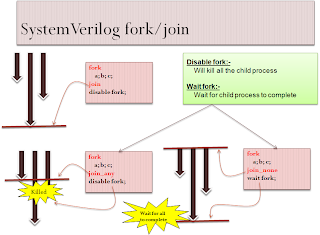
    There are 3 different kind of join keyword in SV, each specifying a different way of waiting for completion of the threads/process created by the fork.
    • join : waits for completion of all of the threads
    • join_any : waits for the completion of the 1st thread, then comes out of fork loop, but lets the other process/thread execute as usual
    • join_none : doesn't wait for completion of any thread, just starts then and immediately exits fork loop.
    Now, suppose you have exited the fork loop by join_none or join_any and after some steps, you want to wait till completion of all the threads spanned by the previous fork loop. SV has "wait fork" for the same.

    Now, suppose you have exited the fork loop by join_none or join_any and after some steps, you want to kill all the threads spanned by the previous fork loop. SV has "disable fork" for the same.

    Next interesting scenario: you have exited fork loop by join_none or join_any and after some steps, you want to kill just one thread (out of many). The solution, have named begin end block and call "disable ". (For example, in the last example if you want to kill only the 2nd thread after exiting the loop via join_any/join_none, then add "disable Second_thread;" at the point where you want to disable the second thread.

    I have created a image to pictorially depict fork/join in SV. Hope that will help understand this in a much better way.

    VMM shorthand macros

    Those who have worked with VMM based verification environment must have encountered situation where you need to code the different essential functions of vmm_data class like copy, psdisplay, compare and so on. This task become very tedious/boring when the number of classes you need to code is substantial, each having lengthy list of data member. Not long back, to get rid of the monotonicity of the above task, I sat for a day and wrote a perl script to generate the complete vmm_data class with essential functions from a class template.

    Well, my one day effort is fixing the same is not worth the effort, as VMM has in-built short-hand-macros to solve it. It's especially useful when you don't have much non-standard data type (which are not supported by VMM shorthand macro)


    class sample_class extends vmm_data;

    // Simple scalar types
    rand bit [7:0] da;
    rand bit [8:0] db [10];
    rand bit dc [];
    rand bit dd [int];
    rand bit de [string];

    ...
    ‘vmm_data_member_begin(sample_class)
    ‘vmm_data_member_scalar(da, DO_ALL)
    ‘vmm_data_member_scalar_array(db, DO_ALL)
    ‘vmm_data_member_scalar_da(dc, DO_ALL)
    ‘vmm_data_member_scalar_aa_scalar(dd, DO_ALL)
    ‘vmm_data_member_scalar_aa_string(de, DO_ALL)
    ‘vmm_data_member_end(sample_class)
    ...
    endclass : sample_class


    Some salient features of VMM shorthand macros are :
    1. They can be used for {scalar, string, enums, vmm_data, handles} x {normal, array, dynamic array, associative array (scalar, and string type)} combination (Total 25 types)
    2. These shorthands are valid for classes derived from vmm_data, vmm_env, vmm_subenv, vmm_xactor, and vmm_scenario
    3. The function which will get implemented depends upon what class your class is being instantiated from.
    4. For unlucky data member which doesn't fall into these 25 category, you can specify the same using `vmm_data_member_user_defined macro
    What I have presented here is a very high level overview of the feature and in no way complete. For interested user please refer these links for complete details:-

    Explain the difference between data types logic and reg and wire

    Ans:-
    To answer this I am not assuming the reader knows the answer for the difference between wire and reg.

    Wire:-

    1. Wires are used for connecting different elements
    2. They can be treated as a physical wire
    3. They can be read or assigned
    4. No values get stored in them
    5. They need to be driven by either continuous assign statement or from a port of a module
    Reg:-
    1. Contrary to their name, regs doesn't necessarily corresponds to physical registers
    2. They represents data storage elements in Verilog/SystemVerilog
    3. They retain their value till next value is assigned to them (not through assign statement)
    4. They can be synthesized to FF, latch or combinational circuit (They might not be synthesizable !!!)
    Wires and Regs are present from Verilog timeframe. SystemVerilog added a new data type called logic to them. So the next question is what is this logic data type and how it is different from our good old wire/reg.

    Logic:-
    1. As we have seen, reg data type is bit mis-leading in Verilog. SystemVerilog's logic data type addition is to remove the above confusion. The idea behind having a new data type called logic which at least doesn't give an impression that it is hardware synthesizable
    2. Logic data type doesn't permit multiple driver. It has a last assignment wins behavior in case of multiple assignment (which implies it has no hardware equivalence). Reg/Wire data type give X if multiple driver try to drive them with different value. Logic data type simply assign the last assignment value.
    3. The next difference between reg/wire and logic is that logic can be both driven by assign block, output of a port and inside a procedural block like this
      logic a;
      assign a = b ^ c; // wire style
      always (c or d) a = c + d; // reg style
      MyModule module(.out(a), .in(xyz)); // wire style


    Reference:-
    1. Cliff's article on the same
    2. Discussion on the same at Verification Guild

    Answers to SystemVerilog Interview Questions - 2

    (86) What is the use of "extern"?
    (66)What is "scope resolution operator"?

    Ans:-
    extern keyword allows out-of-body method declaration in classes. Scope resolution operator ( :: ) links method declaration to class declaration.

    class XYZ;
    // SayHello() will be declared outside the body
    // of the class
    extern void task SayHello();
    endclass : XYZ

    void task XYZ :: SayHello();
    $Message("Hello !!!\n");
    endtask : SayHello


    (76) What is layered architecture ?

    Ans:-
    In SystemVerilog based constrained random verification environment, the test environment is divided into multiple layered as shown in the figure. It allows verification component re-use across verification projects.

    (71)What is the difference between $rose and posedge?

    Ans:-
    posedge return an event, whereas $rose returns a Boolean value. Therefore they are not interchangeable.

    (64)What is "this"?

    Ans:-
    "this" pointer refers to current instance.

    (38)Write a clock generator without using always block.

    Ans:-
    initial begin
    clk <= '0;
    forever #(CYCLE/2) clk = ~clk
    end


    (35)How to implement always block logic in program block ?

    Ans:-

    Use of forever begin end. If it is a complex always block statement like always (@ posedge clk or negedge reset_)

    always @(posedge clk or negedge reset_) begin
    if(!reset_) begin
    data <= '0;
    end else begin
    data <= data_next;
    end
    end

    // Using forever : slightly complex but doable
    forever begin
    fork
    begin : reset_logic
    @ (negedge reset_);
    data <= '0;
    end : reset_logic
    begin : clk_logic
    @ (posedge clk);
    if(!reset_) data <= '0;
    else data <= data_next;
    end : clk_logic
    join_any
    disable fork
    end

    Answers to SystemVerilog Interview Questions - I

    Posting answers to few System Verilog Questions (Please refer System Verilog Interview Questions for questions)

    10> What is the need of virtual interface ?
    Ans:-
    An interface encapsulate a group of inter-related wires, along with their directions (via modports) and synchronization details (via clocking block). The major usage of interface is to simplify the connection between modules.

    But Interface can't be instantiated inside program block, class (or similar non-module entity in SystemVerilog). But they needed to be driven from verification environment like class. To solve this issue virtual interface concept was introduced in SV.

    Virtual interface is a data type (that implies it can be instantiated in a class) which hold reference to an interface (that implies the class can drive the interface using the virtual interface). It provides a mechanism for separating abstract models and test programs from the actual signals that make up the design. Another big advantage of virtual interface is that class can dynamically connect to different physical interfaces in run time.

    For more details please refer the following links


    18> What is difference between $random() and $urandom()
    Ans:-
    1. $random system function returns a 32-bit signed random number each time it is called
    2. $urandom system function returns a 32-bit unsigned random number each time it is called. (newly added in SV, not present in verilog)

    47> How to randomize dynamic arrays of an object
    Ans:-

    class ABC;
    // Dynamic array
    rand bit [7:0] data [];
    
    // Constraints
    constraint cc {
    // Constraining size
    data.size inside {[1:10]};
    
    // Constraining individual entry
    data[0] > 5;
    
    // All elements
    foreach(data[i])
    if(i > 0)
    data[i] > data[i-1];
    }
    endclass : ABC


    Event Region, Scheduling Semantics in System Verilog

    Let me start the post by asking one commonly asked interview question in verilog/system-verilog, that is what is the output of the following block


    always @(posedge clk) begin
    a = 0;
    a <= 1;
    $display(s);
    end


    To begin with let me be clear that this is not the correct way to code in verilog/SV. One shouldn't mix blocking and non-blocking assignment in the same begin-end block. But this question is asked to check the knowledge of scheduling semantics of verilog/SV.

    Verilog scheduling semantics basically imply a four-level deep queue for the current simulation time:-
    1. Active Events (blocking assignment, RHS of NBA, continuous assignment, $display, ...)
    2. Inactive Events (#0 blocking assignment)
    3. Non-Blocking Assign Updates (LHS of NBA)
    4. Monitor Events ($monitor, $strobe).
    Which implies, a=0 will be get printed in this example.

    System Verilog has added few more level queue for simulation, the details of which can be found in these 2 excellent link on scheduling semantics of SV.

    What is Factory Pattern

    If you are working in System Verilog/VMM environment, it is high likely that you will be bombarded with word/expression from OOP world like "Factory Pattern", "Facade Pattern", "Observer Pattern" and so on. There is a finite possibility that you will seat down and start thinking what does those word mean and why they were used too frequently. Let me try to explain the idea/concept behind such word in the simplest way possible.

    In SW engineering, a design pattern (or simply pattern) means a general repeatable solution to a commonly occurring problem. Most of these patterns have similarity to something or other in human society and hence they are known by that name.

    Factory pattern as the name suggest, is aimed at solving the issue of creation of object. (Factory pattern is not the only pattern to deal with creation of objects, there are a bunch of more patterns for handling different kind of cases, and collectively they are known a creational patterns)

    Let me give an example of case where we might need to use creational pattern and how to do so it in SV. Suppose you want to create a "Toy Factory" class which needs to create multiple types of toys (say toy aeroplane, toy tank, toy bus) depending upon the string input to it.

    To create these different types of toys we need to have class defined for them. And there will be common method and data interface for these classes, hence it make sense to put all the common data member/task/functions in a class called toy class and then extend it.

    class TOY;
    // Common data memeber
    string type;

    // Common methods
    virtual function string get_type();
    endclass : TOY

    class TOY_Tank extends TOY;
    function new();
    this.string = "Toy Tank";
    endfunction : new

    string function string get_type();
    return this.string;
    endfunction : get_type
    endclass : TOY_Tank
    class TOY_Bus extends TOY;
    function new();
    this.string = "Toy Bus";
    endfunction : new

    string function string get_type();
    return this.string;
    endfunction : get_type
    endclass : TOY_Bus

    Now we are done with the bothering about the objects to be created. The next problem that we need to solve is to write the toy factory class itself. For simplicity, let's consider the case where we will want to pass 1 to get an instance of tank class and 2 for getting an instance of bus class from the factory. Now the factory class will look like this.
    class TOY_factory;
    Toy my_toy

    // Common methods
    function toy get_toy(int type);
    if(type == 1) this.my_toy = new TOY_Tank();
    if(type == 2) this.my_toy = new TOY_Bus();
    return this.my_toy;
    endfunction : get_toy
    endclass : TOY_factory

    Note that we are using virtual function for bringing polymorphism in action and save us from having an individual instance of the toy type in the factory class.

    Reference

    What is this "System Verilog Callback"

    Callback is one of the major confusing point for a System Verilog learner. Many people have asked the same question in many forums, but the answer doesn't seems to satisfy fully the quest of the person who has raised the querry. I too had the same issue, but I learned it slowly in a hard way. I am presenting here a way in which if I had an answer, I would have learned faster.

    We can pass data member to any function. Now consider a case where you are passing a function (say func1) as a data member to another function (say func2) and you get what is called callback. The reason why it is called callback is that the function func2 now can call anywhere in its code function func1.

    From wikipedia

    In computer programming, a callback is executable code that is passed as an argument to other code. It allows a lower-level software layer to call a subroutine (or function) defined in a higher-level layer.

    Note that SV doesn't give a straight-forward way of passing a function as argument for another function. But we can get the same result (almost we can say!) by using OOP. The idea is to describe all the functions (both func1 type and func2 type) in a base class (don't implement the funct2 kind of function and make them virtual for polymorphism), and then extend the class to a derived class where you implement the func2 type of function.

    Example:-
    class abc_transactor;
    virtual task pre_send(); endtask
    virtual task post_send(); endtask

    task xyz();
    // Some code here
    this.pre_send();
    // Some more code here
    this.post_send();
    // And some more code here
    endtask : xyz
    endclass : abc_transactor

    class my_abc_transactor extend abc_transactor;
    virtual task pre_send();
    ... // This function is implemented here
    endtask

    virtual task post_send();
    ... // This function is implemented here
    endtask

    endclass : my_abc_transactor

    Now let me explain how it is going to work. The base class abc_transactor has 3 tasks, 2 of which are declared virtual and are not implemented. But they are being called from another task xyz() which is fully implemented. The unimplemented virtual task are called callback class.

    The child class, which extends from the base class, implements the previous unimplemented tasks. It inherits the xyz() task from the base class and hence doesn't need to change it. By this we can inject executable code to a function without modifying it.

    Now the next question is why is done. There are many reasons for it.
    1. The biggest advantage is that you can modify the behavior of task xyz() without modifying it in the base or child class. It is a big advantage as no one wants to fiddle with known good functioning code.
    2. Consider a case where you are writing a base class which is going to be used by multiple test environment, and for each test environment a known part of the code, or a known function/task is going to change. The natural choice is to implement those change-in-every-case functions/tasks as callback method and let the user extend your base class with specifying only that part of the code which need to be changed in his case.
    Simple callback using the above approach does have some known limitations, which can be solved using design patterns (from OOP land), the details of which can be found at Janik's article of vmm_callback.

    Reference:-

    About Me

    My photo
    I am from Sambalpur, Orissa, India. Have done Btech and Mtech in ECE from IIT Kharagpur. Currently working as Lead Member Technical Staff at Mentor Graphics Noida

    My Feedburner

    Followers

    Search This Blog

    My Shelfari Bookshelf

    Shelfari: Book reviews on your book blog


    Traffic Summary